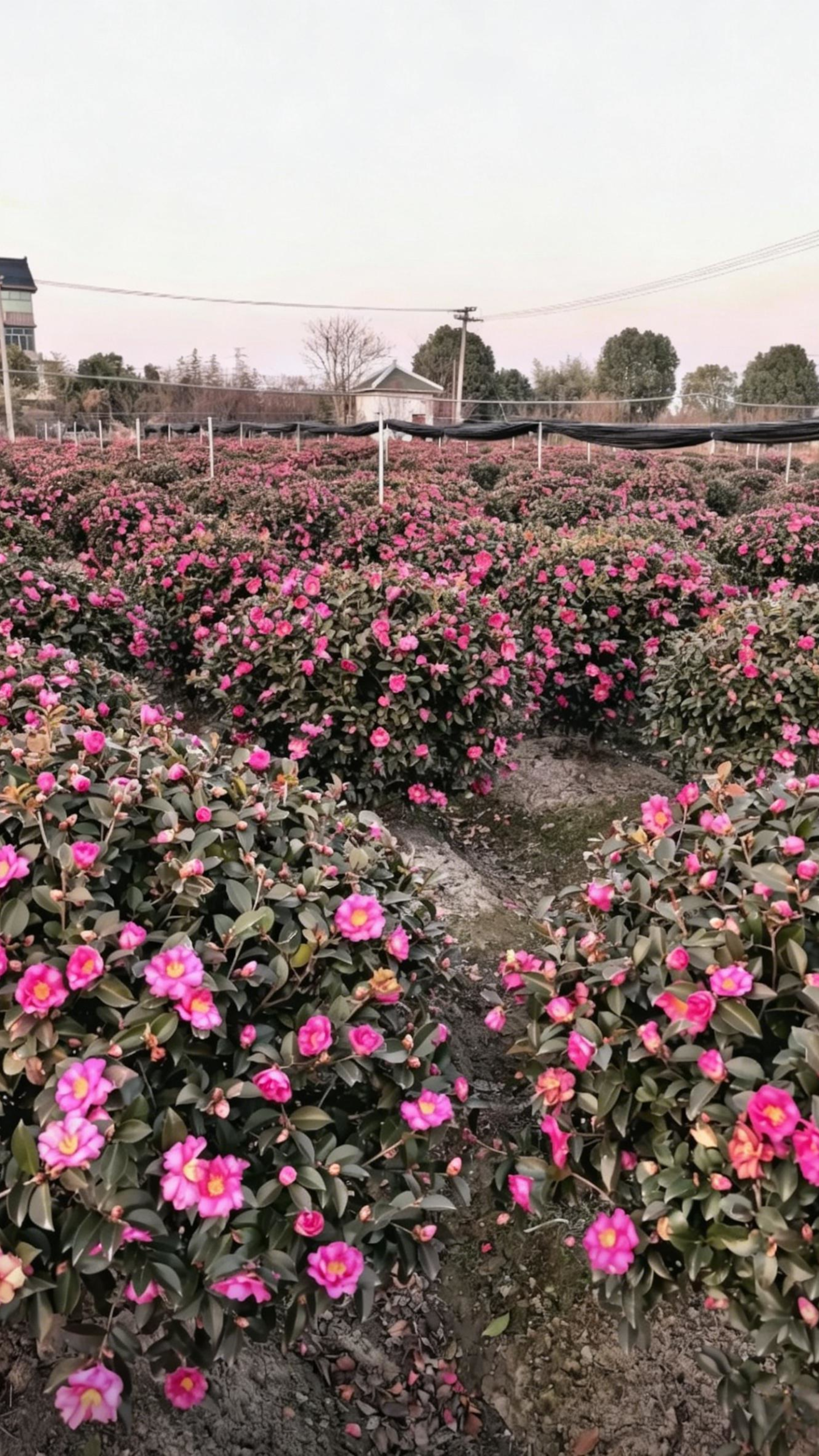
Scientific Name: Camellia sasanqua Thunb. (Sasanqua Camellia Pruned Topiary)
Aliases: Sasanqua Topiary Ball, Mountain Camellia Ball
Plant Classification: Theaceae, Camellia Genus · Evergreen Shrub → Pruned Topiary Ball
1. Variety Characteristics
-
Original Morphology: An evergreen shrub with grayish-brown hairless twigs. Leaves are alternate, leathery, elliptical to ovate, deep green and glossy with finely serrated edges. Flowers are solitary or paired in axils, with 5–7 petals (more in double-flowered varieties), in white, pink, or deep red (blooming from October to March, peaking in winter and spring). Capsules are subglobose and dehisce when mature.
-
Topiary Description: This product is an evergreen spherical or semi-spherical ball formed from Sasanqua Camellia cuttings through multiple rounds of pinching and pruning. It features dense branching and small, thick leaves. It can be finely pruned into a mirror-smooth ball or a natural textured ball (due to slow growth, it maintains its shape for a long time).
-
Seasonal Performance: Evergreen throughout the year, blooming in winter and spring. New leaves in autumn and winter are deep green and bright. It is a rare "evergreen foliage + winter flowering" topiary ball.
2. Ecological Habits
-
Light: Prefers semi-shade and avoids intense direct sunlight (especially summer afternoon sun, which causes leaf scorch). Suitable for planting under sparse forests or on the east or north sides of buildings. Flower bud differentiation requires an appropriate amount of scattered light.
-
Soil: Strictly prefers acidic, loose, humus-rich, and well-drained forest soil or mountain mud (pH 5.0–6.5). Avoids alkaline soil, heavy clay, and waterlogging.
-
Resistance: Relatively cold-hardy (can withstand short-term low temperatures of -5 to -8°C; suitable for open-field cultivation in East, Central, and South China; requires indoor potting in North China). Tolerates pruning well but grows slowly. Few pests and diseases, with occasional scale insects or algal leaf spot.
3. Landscape Application Scenarios
-
Entrance/Forecourt Accent: Premium finely-pruned balls can be planted individually or in pairs on both sides of entrance steps or beside foyers, adding elegance with winter and spring flowers.
-
Forest Edge/Understory Planting: Combined with Photinia balls or Boxwood balls, they can be scattered under tree arrays or used in the foreground of flower borders to fill the winter flowering gap.
-
Potted/Mobile Greening: With its regular shape, it is also frequently planted in high-end stone containers for display in hardscape plazas or commercial entrances.
4. Plant Quality Indicators (Example — Fine-Pruned Topiary Ball)
| Project Item | Specifications |
|---|---|
| Crown Width (P) | 60–80 cm / 80–100 cm / 100–120 cm and above |
| Height (H) | Usually H ≈ P or H = P + 10–20 cm (from base to top of ball) |
| Branching Point (from ground) | Usually very low; multi-stem topiary near the soil surface or base |
| Quality Requirements | Spherical shape is round and symmetrical; leaf color is deep green and glossy; no obvious gaps or dead branches; supplied with flower buds in winter and spring (Nov-Feb). |
5. Planting and Maintenance Key Points
-
Planting Period: Best in early spring before budding (Feb-Mar) or in autumn after leaf fall; container seedlings can be planted year-round.
-
Pruning: Topiary balls require a major pruning once a year after flowering (April) to remove spent flowers and cut back overgrown branches to maintain the shape; perform 1–2 light trimmings during the growing season (June–Sept).
-
Water and Fertilizer: Prefers moist conditions but avoids waterlogging; apply acidic organic fertilizer (such as fermented soybean cake) in spring, and phosphorus-potassium fertilizer in autumn to promote flower bud development.