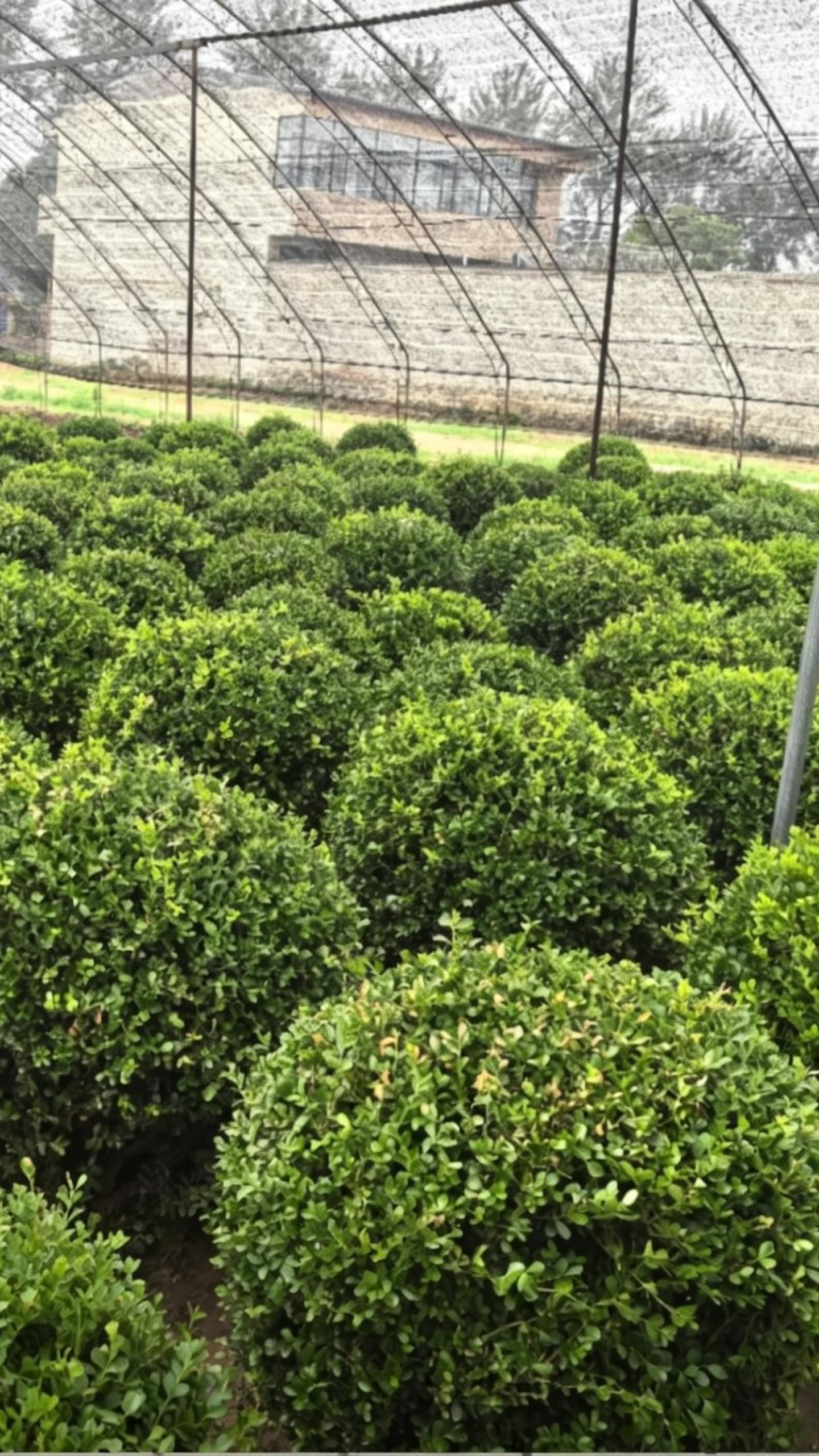
-
Scientific Name: Buxus sinica var. parvifolia (Boxwood Topiary Seedling)
Aliases: Small-leaf Boxwood Ball, Dwarf Boxwood Ball, Boxwood Topiary Sphere
Classification: Buxaceae, Buxus · Evergreen Shrub → Pruned Topiary Category
1. Variety Characteristics
-
Original Form: An evergreen shrub with four-angled branchlets densely covered in pubescence. Leaves are opposite, leathery, elliptical or obovate, 1–2 cm long. The leaf shape is tiny like a sunflower seed, deep green, and glossy.
-
Topiary Description: This product is a regular spherical topiary seedling cultivated over many years and finely pruned from Littleleaf Boxwood. The foliage is extremely dense, providing a thick and uniform texture. It is one of the most classic and high-end evergreen topiary balls in landscaping.
-
Seasonal Performance: Evergreen throughout the year. Old leaves are dark green, while new spring leaves are bright green. It offers excellent landscape stability and a long shape-retention period due to its relatively slow growth.
2. Ecological Habits
-
Light: A neutral species that loves sunlight but is also highly shade-tolerant. It grows faster in full sun but maintains a deep green color even in shaded woodland areas.
-
Soil: Prefers fertile, loose, well-drained neutral or slightly alkaline sandy loam. It is also tolerant of poor soils but sensitive to waterlogging.
-
Resistance: Highly cold-resistant (cultivatable in East, Central, North, and parts of Northwest China). It is resistant to smoke, dust, and harmful gases (such as sulfur dioxide). It has strong sprouting ability and is extremely tolerant of pruning.
3. Engineering Application Scenarios
-
Formal Gardens/Forecourts: Symmetrical placement in European-style gardens, modern minimalist plazas, or government entrances to reflect solemnity and refinement.
-
Exquisite Flower Borders: Used as a background or visual center in high-end residential flower borders, utilizing its tight texture to create a premium atmosphere.
-
Bonsai Styling: Due to its slow growth, long lifespan, and small leaves, it is often used as material for large bonsai or displayed directly in pots.
4. Quality Indicators (Example — Specially Pruned Topiary Ball)
Item Name Specifications Crown Width (P) 60–80 cm / 80–100 cm / 100–120 cm / 150 cm+ Height (H) Usually H ≈ P or H = P + 10 cm Quality Requirements Spherical, round and symmetrical; extremely dense foliage without hollows; no obvious mechanical damage; dark green leaves without disease spots. 5. Planting and Maintenance Key Points
-
Planting Season: Best in Spring and Autumn; containerized seedlings can be planted year-round.
-
Pruning: Extremely tolerant of pruning. Pruning 1–2 times during the growing season (May–October) is sufficient to maintain a good shape (due to slower growth compared to Privet).
-
Pest Control: Focus on preventing the Box Tree Moth (Cydalima perspectalis); apply pesticides during peak infestation periods.
-