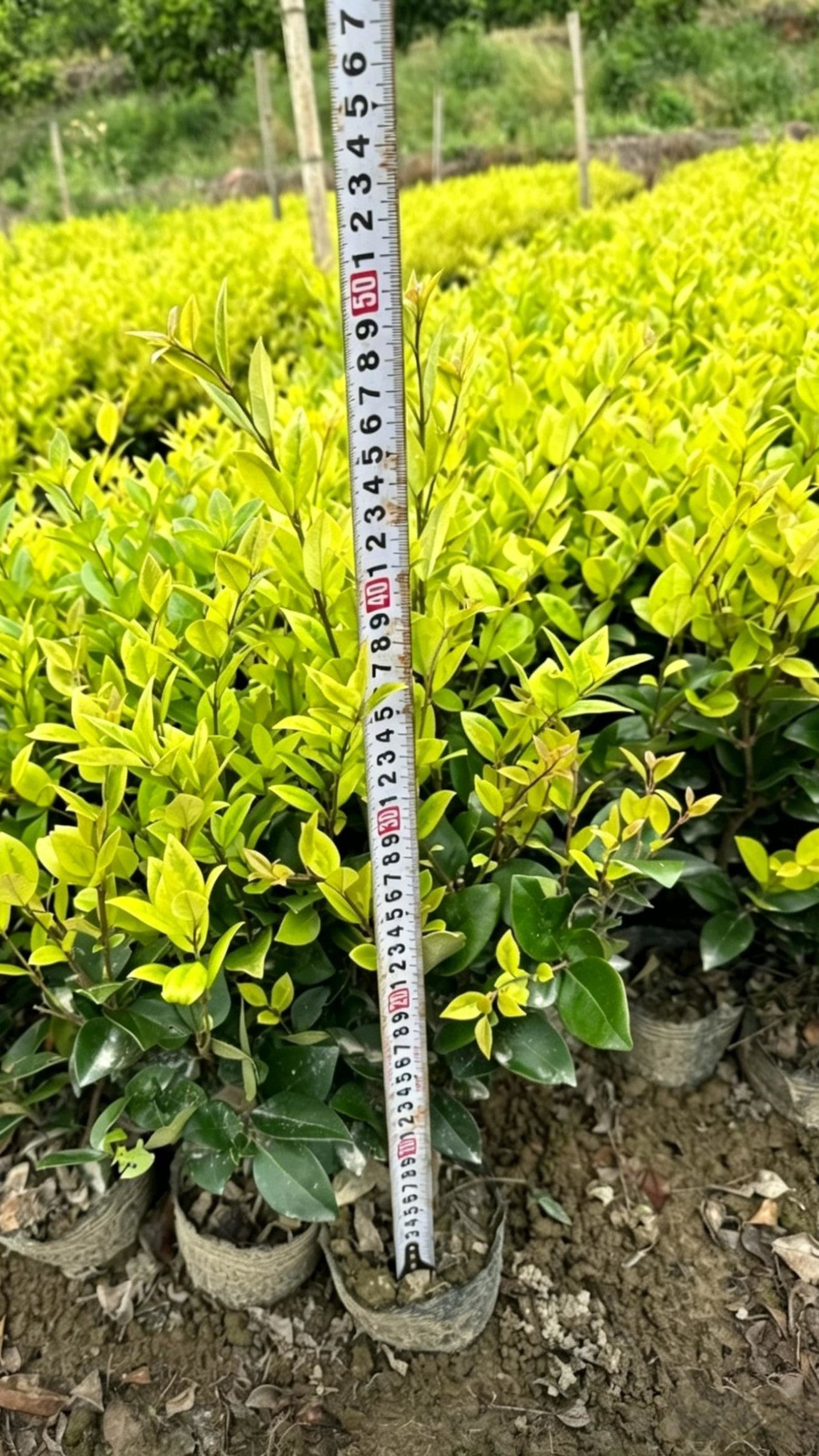
Scientific Name: Ligustrum japonicum 'Howardii' (Golden Japanese Privet, cultivar of Japanese Privet)
Common Names: Golden Japanese Privet, Variegated Privet
Classification: Oleaceae, Ligustrum – Evergreen Shrub / Colorful Leaf Block, Hedge and Topiary Ball
1. Variety Characteristics
-
Original Species Morphology: Evergreen shrub or small tree, height up to 3–5 m; leaves opposite, leathery, obovate to elliptical, 5–12 cm long.
-
Colorful Leaf Characteristics: New leaves and young shoots of this variety in spring, summer, and autumn are bright golden yellow or yellow-green; the center of mature leaves gradually turns dark green, while the edges or new shoots retain the golden yellow; under low winter temperatures, the golden part fades slightly to yellow-green but remains distinct; an excellent year-round colorful evergreen shrub.
-
Flowers and Fruits: Terminal panicles, flowers white (May–June), slightly fragrant; drupes blue-black (October–November).
-
Seasonal Interest: Evergreen in all four seasons; new leaves are bright golden from spring to autumn, with dark green old leaves providing a backdrop; remains evergreen in winter with a slight yellow tint.
2. Ecological Habits
-
Light: Light-loving, also tolerates partial shade; the more sufficient the light, the brighter the golden yellow of new leaves; too much shade causes the golden yellow to fade or even turn green.
-
Soil: Highly adaptable to soil types, suitable for loose, fertile, well-drained slightly acidic to neutral sandy loam; avoids long-term waterlogging.
-
Resistance: Relatively cold-hardy (can withstand short-term low temperatures of -10 to -12°C, cultivated in open ground in Central and East China); drought-tolerant, tolerant of pruning, tolerant of urban pollution and light salinity; strong sprouting ability; more tolerant of high temperature and humidity than Ligustrum x vicaryi (deciduous type); few pests and diseases.
3. Engineering Application Scenarios
-
Patterned Color Blocks: Combined with Photinia x fraseri, Loropetalum chinense, and Buxus sinica var. parvifolia to form the classic "gold-red-purple-green" layers, suitable for road dividers, plazas, and parks.
-
Evergreen Foliage Hedges: Densely planted as medium-to-high hedges or background partitions, providing both screening and colorful foliage effects.
-
Topiary Balls/Pillars: Pruned into Howardii balls or pillars, planted specimens or in rows at entrances and lawn nodes.
-
Foundation Planting: Around building perimeters and garden paths to fill in with evergreen colorful foliage.
4. Nursery Stock Quality Indicators
① Color Block / Hedge Container Seedlings
|
Item Name |
Specifications |
|---|---|
|
Age |
1–2 year old cutting seedlings |
|
Height (H) |
30–40 cm / 40–50 cm / 50–60 cm (by design) |
|
Crown Width (P) |
≥ 20–30 cm, low branching, number of branches ≥ 3–5 |
|
Container Requirements |
Nutritional cup diameter 10–12 cm / 12–15 cm, roots not girdled |
|
Quality Requirements |
New leaves clearly golden, no severe greening, no scale insects or anthracnose |
② Topiary Ball
|
Item Name |
Specifications |
|---|---|
|
Crown Width (P) |
P60 / P80 / P100 / P120 / P150 cm |
|
Height (H) |
≈ 0.8–1.0 times the crown width, round and full shape |
|
Root Ball Size |
Crown width ≥ 100 cm: root ball ≈ 1/3 of crown width, wrapped with straw rope |
|
Quality Requirements |
Maintenance pruning completed (specify rough/finished), new leaves golden, dense interior |
5. Planting and Maintenance Points
-
Planting Season: Best in spring or autumn; container seedlings can be planted year-round (avoid extreme heat and cold).
-
Pruning: Prune color blocks 1–2 times a year (late spring and early autumn) to control height and width; ball plants receive light pruning during the growing season to maintain shape, and heavy pruning in early spring to promote branching; top-dress with P and K fertilizer after pruning to make new leaves golden.
-
Water and Fertilizer: Thorough initial watering; top-dress with NPK compound fertilizer during the growing season; avoid excessive nitrogen fertilizer (too much nitrogen makes new leaves larger but sparse, and the golden color fades); avoid waterlogging.
-
Pests and Diseases: Watch for scale insects, aphids, and anthracnose; maintain good ventilation and treat promptly.