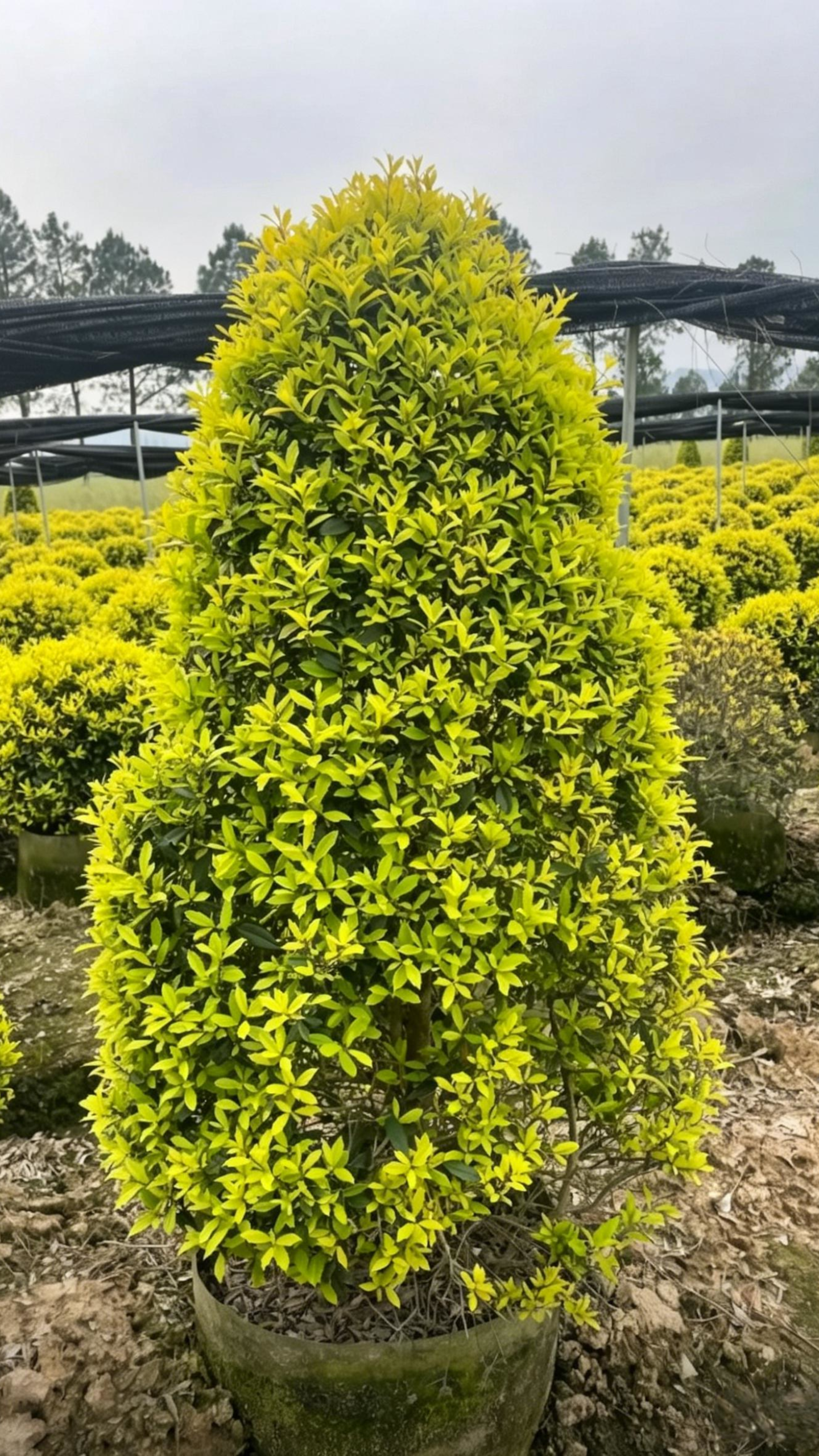
-
Scientific Name: Ilex × attenuata 'Sunny Foster' (Golden Foster's Holly / Golden-leaved Holly Topiary Seedling)
Synonyms: Golden-leaved Holly Ball, Yellow-leaved Holly Ball
Seedling Classification: Aquifoliaceae, Ilex - Evergreen Shrub / Small Tree → Pruned Topiary Ball
1. Varietal Characteristics
-
Original Form: Evergreen shrub or small tree, bark grey-brown and smooth; leaves alternate, leathery and glossy, elliptical.
-
Leaf Color: New leaves are bright golden yellow, maintaining bright yellow or lemon yellow from spring to early autumn (stronger light results in more golden leaves); old leaves gradually turn yellow-green, becoming slightly dark green in winter; bright red drupes appear in autumn and winter, persisting until the following spring.
-
Topiary Description: This product is an evergreen spherical or hemispherical ball formed from Golden Foster's Holly cuttings through multiple pinching and pruning. It features dense branching, small and compact leaves, and is highly resistant to repeated pruning for shape retention.
2. Ecological Habits
-
Light: Prefers light, also semi-shade tolerant; foliage is more golden under strong light, and prone to turning green in excessive shade.
-
Soil: Prefers loose, fertile, well-drained slightly acidic to neutral sandy loam or humus soil; avoid waterlogging and saline-alkali compacted soil.
-
Resistance: Relatively cold-hardy (can overwinter in open ground in the Yangtze River basin, tolerating temperatures around -10°C), moderate drought resistance, resistant to urban pollution and light salinity, strong budding power, extremely resistant to pruning, with few pests and diseases.
3. Landscape Application Scenarios
-
Color Leaf Node Highlights: Solitary planting or scattered in small groups on lawns or at corners of flower borders; paired with Red Tip Photinia balls and Ligustrum sinense balls to create a classic "Yellow-Red-Green" contrast.
-
Formal Planting: Symmetrical rows at entrance squares, along walkways, or in front of feature walls to serve as evergreen ball barriers.
-
Fruiting Landscape: In addition to the golden-yellow leaves, the bright red fruits in autumn and winter add seasonal variation and richness to the landscape.
4. Quality Indicators (Example — Landscape Topiary Ball)
Item Name Specifications Crown Width (P) 60–80 cm / 80–100 cm / 100–120 cm / Above 150 cm Height (H) Usually H ≈ P or H = P + 10 cm Quality Requirements Spherical and smooth, uniform leaf distribution, bright yellow leaf color without spots, no serious mechanical damage. 5. Planting and Maintenance Key Points
-
Planting Season: Spring and autumn are best; container seedlings can be planted year-round.
-
Pruning: Prune 2–3 times during the growing season (May–October) to maintain the ball shape; clear dead branches inside the ball to maintain ventilation.
-
Water and Fertilizer: Fertilizer-loving, apply compound fertilizer 2–3 times a year, with increased nitrogen fertilizer in spring to promote bright yellow foliage.
-