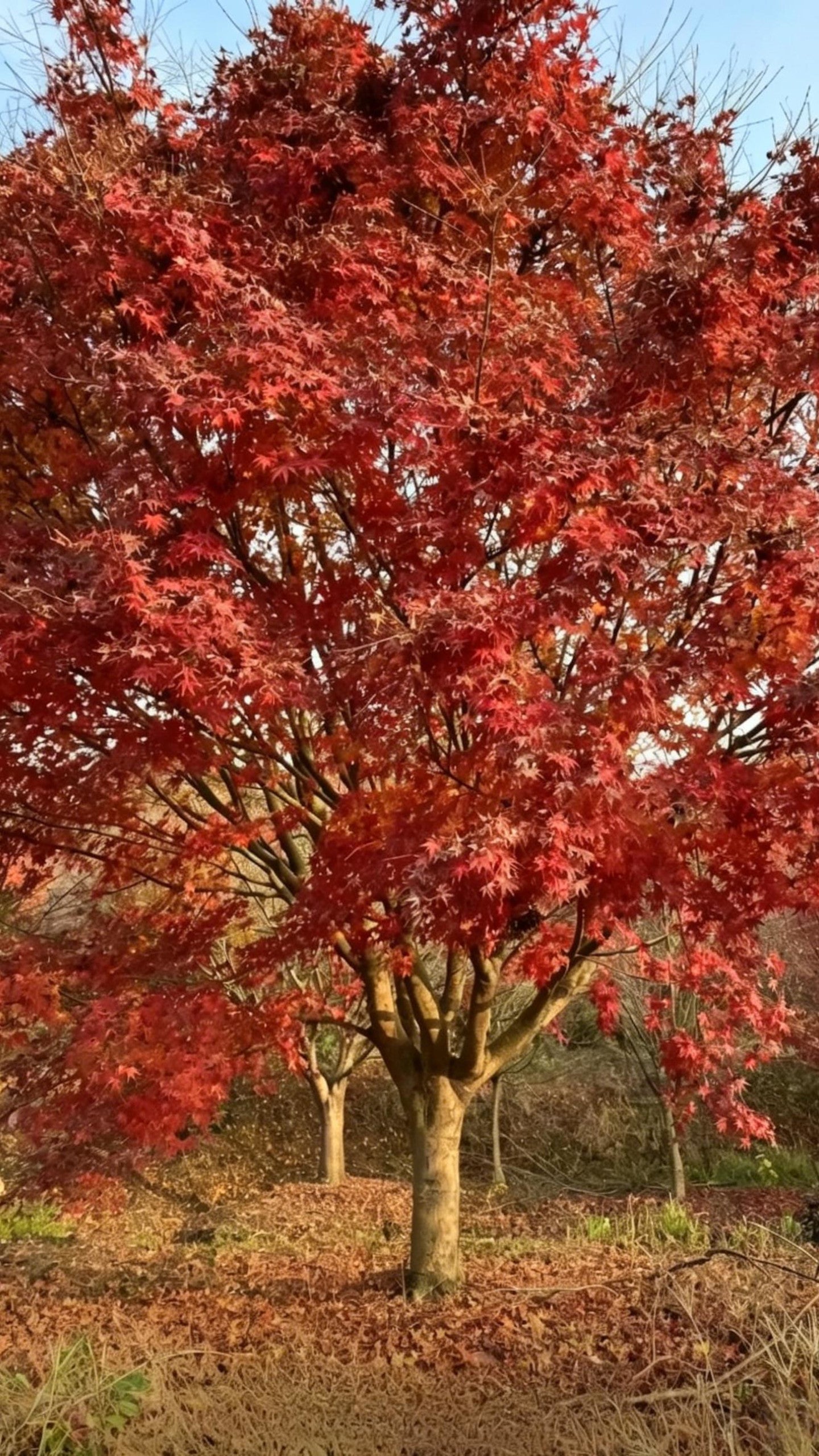
Scientific Name: Acer palmatum Thunb.
Aliases: Green Maple, Chicken Claw Maple, Japanese Maple
Classification: Sapindaceae (formerly Aceraceae), Acer - Deciduous small tree / Colorful foliage tree
1. Varietal Characteristics
-
Plant Morphology: Deciduous small tree, 3–8 (up to 10) m tall; bark dark gray, smooth; twigs thin, purple or gray-brown; leaves opposite, palmately 5–9 deeply lobed (usually 7-lobed), lobes lanceolate or oblong-lanceolate, margins sharply serrate, resembling chicken claws; leaf color changes significantly with seasons.
-
Seasonal Performance (Core Ornamental Point):
-
Spring: New leaves are tender green or reddish, delicate and lovely.
-
Summer: Leaves are deep green, the tree posture is graceful, providing dense shade.
-
Autumn: Leaf color turns bright red, orange-red, or golden yellow (varietal differences are large), the most spectacular viewing period.
-
-
Flowers and Fruits: Terminal corymbs, flowers purple; samaras yellowish-brown when ripe, two wings spread at an obtuse angle.
2. Ecological Habits
-
Light: Prefers semi-shaded environments (half-day sun is best), avoid strong direct sunlight (especially western exposure in summer, which can cause leaf scorch and burns); leaf color is duller in strong light and more vibrant in semi-shade.
-
Soil: Strictly prefers acidic, loose, fertile, and well-drained sandy loam (pH 5.5–6.5); avoid alkaline soil (prone to chlorosis) and waterlogging (prone to root rot).
-
Resistance: Relatively cold-hardy (can withstand short-term low temperatures around -15°C, cultivated in open ground in southern North China and further south), not drought-tolerant, not waterlog-tolerant; moderate growth speed, strong sprouting ability.
3. Engineering Application Scenarios
-
Solitary Planting for Focus: Suitable for solitary planting on lawns, by ponds, near rocks, or in wall corners; it is a representative focus tree species of Jiangnan gardens.
-
Clump/Group Planting: Combine with evergreen trees (such as Cinnamomum camphora, Ligustrum lucidum) as a background to create color blocks using red-green contrast, or as an understory species at the forest edge on slopes.
-
Bonsai/Container Seedlings: Beautiful tree form and posture, very easy to shape, a precious courtyard potted plant and garden container masterpiece.
4. Sapling Quality Indicators
|
Project Name |
Specification Parameters |
|---|---|
|
DBH / Meter Diameter |
Φ 3 cm / Φ 5 cm / Φ 6 cm (Graded by design) |
|
Height (H) |
200–350 cm (Matching DBH) |
|
Crown Width (P) |
≥ 150–250 cm, uniform and full crown, no lopsidedness |
|
Branching Point |
Uniform and neat (usually 80–120 cm or as required), 3–5 main branches distributed in layers |
|
Earth Ball Specification |
8–10 times the DBH, complete root system |
|
Quality Requirements |
Good healing of the graft union (if grafted), no quarantine pests or diseases, no mechanical damage to the bark, specify the variety (e.g., 'Beni-maiko', 'Sangokaku', etc.) |
5. Planting and Maintenance Points
-
Planting Period: Best from after autumn leaf fall to before early spring budding; container seedlings can extend the construction period (avoiding intense summer heat).
-
Water and Fertilizer: Thoroughly water after planting; keep soil moist during the growing season but avoid waterlogging; apply decomposed organic fertilizer or acidic compound fertilizer in spring and autumn, avoid excessive nitrogen fertilizer (which can lead to excessive branch growth and duller leaf color).
-
Pruning: Thin out dense, crossing, or inward-growing branches during the winter dormant period, avoid heavy pruning of large branches; promptly remove sprouts from the rootstock during the growing season.
-
Pest and Disease Control: Focus on controlling stem-boring pests (longhorn beetles), slug caterpillars, aphids, and leaf spot disease; in alkaline soil areas, regularly water with ferrous sulfate to prevent chlorosis.