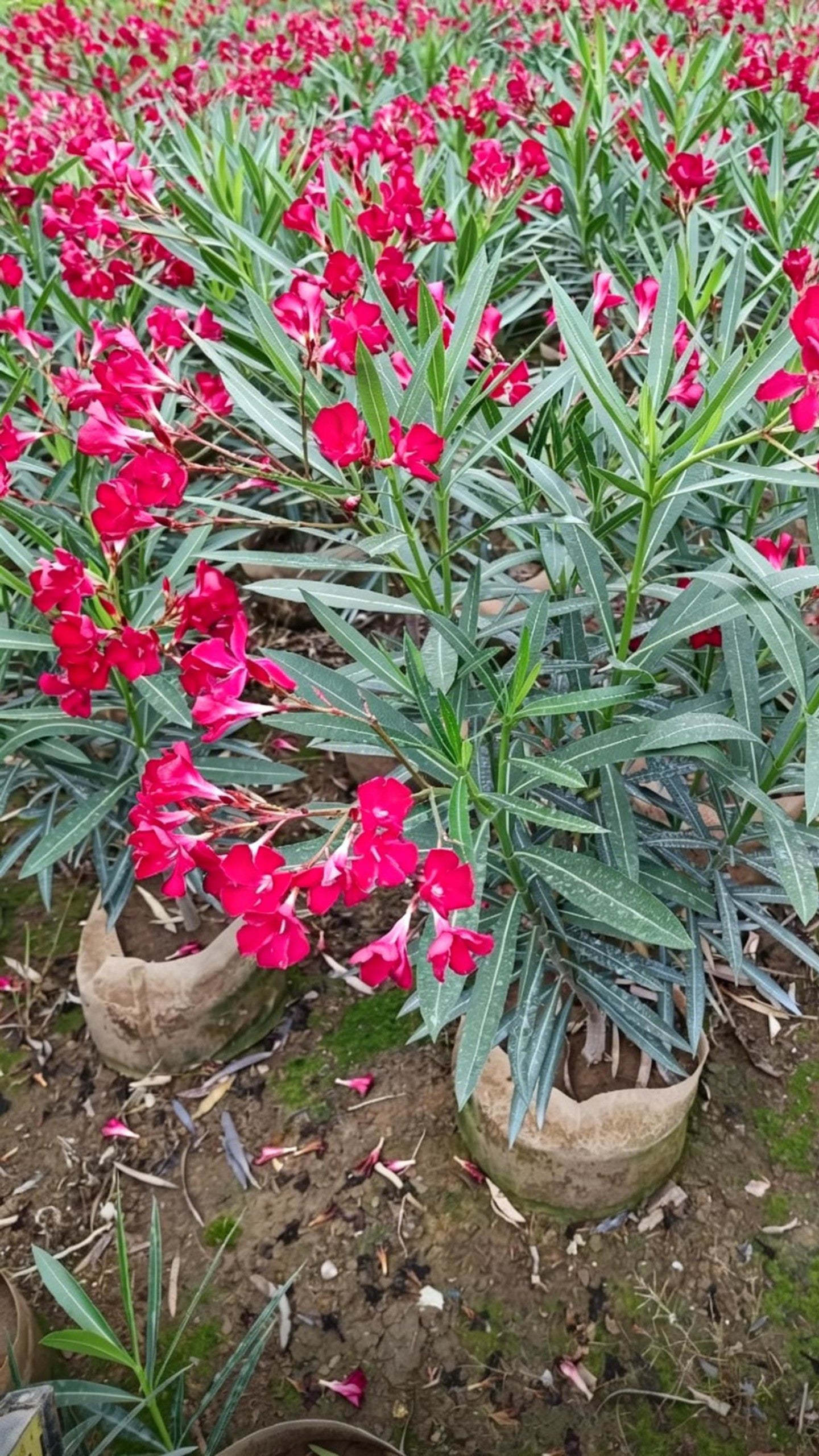
Scientific Name: Nerium oleander L.
Aliases: Rose Bay, Willow-leaf Peach, Oleander
Classification: Apocynaceae, Nerium - Evergreen shrub or small tree / Pollution-resistant flowering shrub
1. Varietal Characteristics
-
Plant Morphology: Evergreen shrub or small tree, 2–5 (up to 6) m tall; stems erect, highly branched, bark grayish-brown; leaves 3–4 whorled (rarely opposite), lanceolate or narrow-lanceolate, 7–15 cm long, entire, leathery, dark green and glossy on the upper surface, resembling bamboo leaves; the whole plant contains milky sap.
-
Flower Performance: Terminal cymes, corolla funnel-shaped, 5-lobed, 3–5 cm in diameter; common colors are pink, deep red, white, and variegated; double-flowered varieties (red double, white double) are most commonly used in engineering; flowering period from May to October (continuous blooming in summer and autumn), individual flowers have a short life but the inflorescences open sequentially, so the overall blooming period is very long.
-
Fruit: Follicles long-cylindrical, seeds with terminal hairs (rarely produces seeds).
-
Seasonal Performance: Evergreen all year round, with continuous flowers in summer and autumn, a very important stress-resistant flowering shrub.
2. Ecological Habits
-
Light: Sun-loving species, prefers full sun; ample light ensures a large volume of flowers and vibrant colors; slight partial shade is acceptable, but too much shade results in fewer and paler flowers.
-
Soil: Strong adaptability to soil, tolerates poor and saline-alkaline soil (can grow in soil with 0.5% salt content); thrives in loose, well-drained sandy loam; avoid waterlogging.
-
Resistance: Extremely heat-tolerant, extremely drought-tolerant, pruning-resistant, strong sprouting ability; extremely resistant to harmful gases such as sulfur dioxide, chlorine, and hydrogen fluoride, strong dust absorption capacity, suitable for industrial areas and road greening; few pests and diseases (occasionally aphids, scale insects, brown spot disease).
3. Engineering Application Scenarios
-
Road/Highway Greenbelts: Central dividers or roadside greenbelts as background trees or isolation belts, resistant to exhaust and highly effective for isolation.
-
Industrial Areas/Coastal Greenbelts: Primary choice for factory greening and coastal windbreaks due to its strong pollution resistance and salt-alkali tolerance.
-
Park/Garden Landscaping: Clump planting or row planting as flowering hedges or background trees for late summer and autumn interest.
4. Sapling Quality Indicators
① Engineering Container Seedlings (for Hedges/Color Blocks)
|
Project Name |
Specification Parameters |
|---|---|
|
Sapling Age |
1–2 year old cuttings |
|
Height (H) |
60–80 cm / 80–100 cm / 100–120 cm (per design) |
|
Crown Width (P) |
≥40–60 cm, low branching, number of branches ≥3–5 |
|
Container Requirements |
Nutrition pot diameter 15–20 cm / Gallon pot 2–3 gal, roots not bound |
|
Quality Requirements |
Normal leaf color, no serious brown spot disease, specify flower color (pink/dark red/white) |
② Large Field Seedlings (for Solitary/Background Planting)
|
Project Name |
Specification Parameters |
|---|---|
|
Height (H) |
150–200 cm / 200–250 cm |
|
Crown Width (P) |
≥100–150 cm, uniform crown |
|
Earth Ball Specification |
8–10 times the ground diameter |
|
Quality Requirements |
Uniform branching point (usually 30–50 cm), no pests or diseases, no damage to the bark |
5. Planting and Maintenance Points
-
Planting Period: Spring and autumn are best; container seedlings can be constructed year-round (avoiding intense summer heat).
-
Pruning: Light pruning after flowering or in winter to control height and width; wear gloves when pruning to avoid contact with the sap; dispose of pruning waste centrally, do not compost it.
-
Water and Fertilizer: Thoroughly water after planting; apply decomposed organic fertilizer or compound fertilizer during the growing season, and extra phosphorus and potassium fertilizer before flowering; drought-tolerant, but keeping soil moist during the growing season leads to more flowers.
-
Toxicity Reminder: The whole plant is toxic; do not plant in children's playgrounds or areas with frequent animal activity; wash hands promptly after handling.