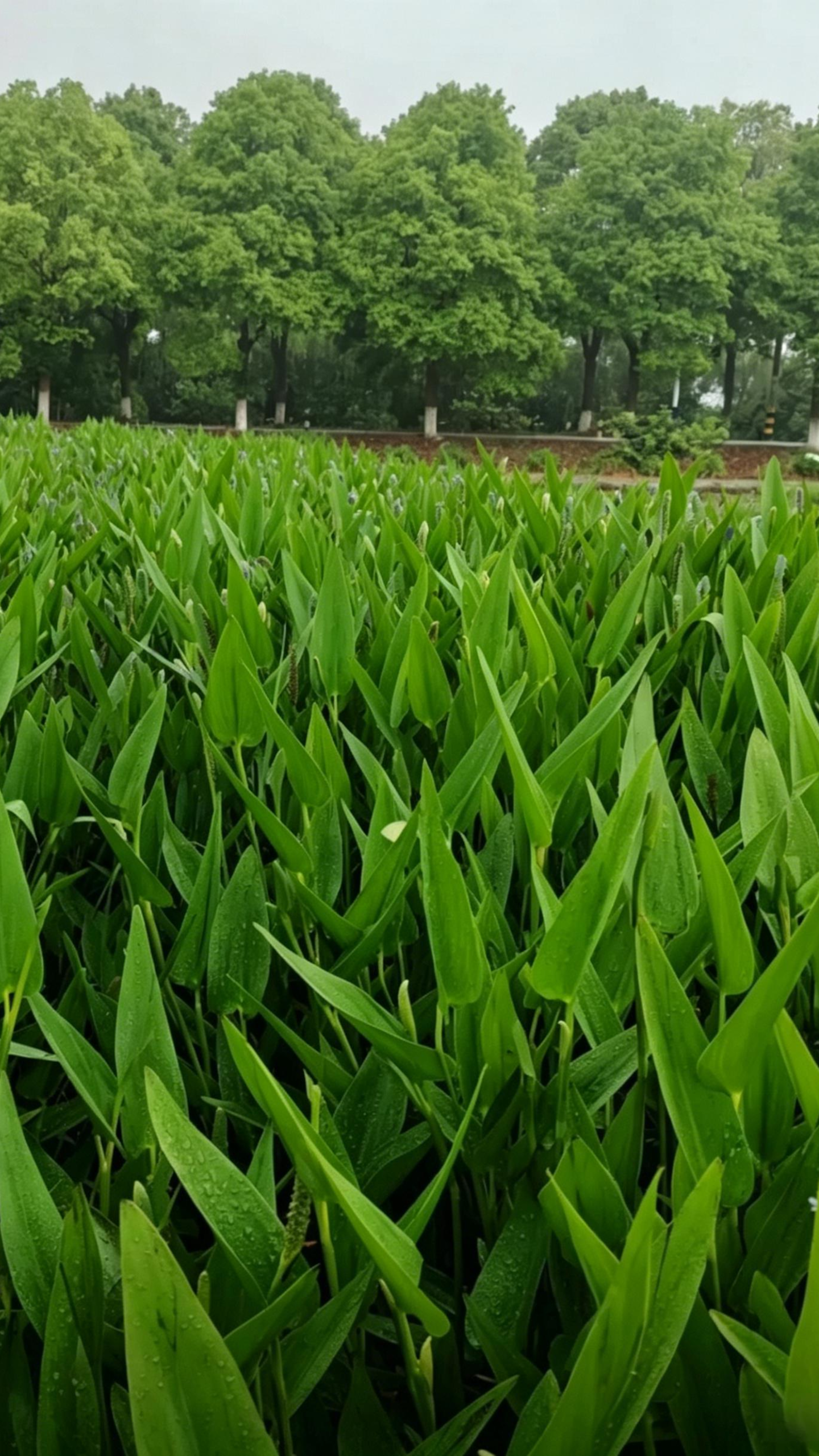
Scientific Name: Pontederia cordata L.
Alias: North American Pickerelweed, Haishouhua (Commonly known in some markets)
Plant Classification: Family Pontederiaceae, Genus Pontederia · Perennial emergent/floating-leaved aquatic herb / Wetland aquatic flower
1. Variety Characteristics
-
Plant Morphology: Possesses thick underground rhizomes; basal leaves with long petioles; leaf blades are ovate-lanceolate or broad-lanceolate, 10–25 cm long, with entire margins and arcuate veins, bright green in color; flower stalks stand erect and higher than the foliage, topped with dense racemes; small flowers are bell-shaped, blue-purple or white (cultivated varieties are mostly blue-purple); flowering period is June–September, followed by capsule fruits.
-
Common Varieties: The original blue-flowered Pickerelweed is most commonly used; others include white-flowered varieties (P. cordata 'Alba') and large-sized types. Projects typically select standard blue-flowered medium-sized plants.
-
Seasonal Performance: Germination in spring → Peak blooming in summer and autumn (long colony flowering period) → Above-ground parts wither in winter, with underground rhizomes overwintering.
2. Ecological Habits
-
Water Level Requirements: Suitable for shallow water areas or moist shores; ideal water depth is 10–30 cm (maximum not exceeding 50 cm). Can also be planted in saturated moist mud; avoid complete drought and long-term fast-flowing water.
-
Lighting: Light-loving; adapts to full sun to light partial shade. Abundant light results in dense flower clusters; excessive shade reduces blooming.
-
Soil: Prefers clayey pond mud, river mud, or swamp soil rich in organic matter; tolerates moderate fertility.
-
Temperature: Optimal growth temperature is 20–30°C. Growth stops when the temperature falls below 10°C. Underground rhizomes can withstand around -10°C (if mud does not freeze). Mostly used for open-field cultivation in Central and East China; needs protection or annual replanting in Northeast regions.
3. Engineering Application Scenarios
-
Artificial Lakes/Pond Shallow Water Zones: Planted in mass along shallow shorelines to soften hard revetments; pairs well with Lotus, Water Lily, Sweet Flag, and Thalia dealbata to form aquatic plant communities.
-
Flower Borders/Wetland Beautification: Utilizes its long blue-purple flowering period for foreground or midground landscaping, providing stable color effects.
-
Water Quality Purification: Excellent absorption of nitrogen and phosphorus; commonly used in constructed wetland projects.
4. Seedling Quality Indicators (Example - Engineering Emergent Seedlings)
| Item Name | Specification Parameters |
|---|---|
| Age/Form | 1–2 year old divided seedlings / Pot-grown seedlings (Recommended for projects) |
| Height (H) | 40–60 cm / 60–90 cm (Leaves can be trimmed before shipping) |
| Clump Dia/Tillers | ≥ 3–5 buds (stems) per clump, with thick rhizomes |
| Container Size | Pot diameter 12–15 cm / 15–18 cm, fully developed root system |
| Quality Requirements | Bright green leaves, pest and disease-free, vigorous growth |
5. Planting & Maintenance Key Points
-
Planting Season: From spring germination to early autumn; pot-grown seedlings can be planted year-round.
-
Pruning: Promptly remove spent flower stalks to prevent seed setting from consuming nutrients; clean surface debris after withering in winter.
-
Water & Fertilizer: Maintain a shallow water environment; apply appropriate top-dressing during the growing season.