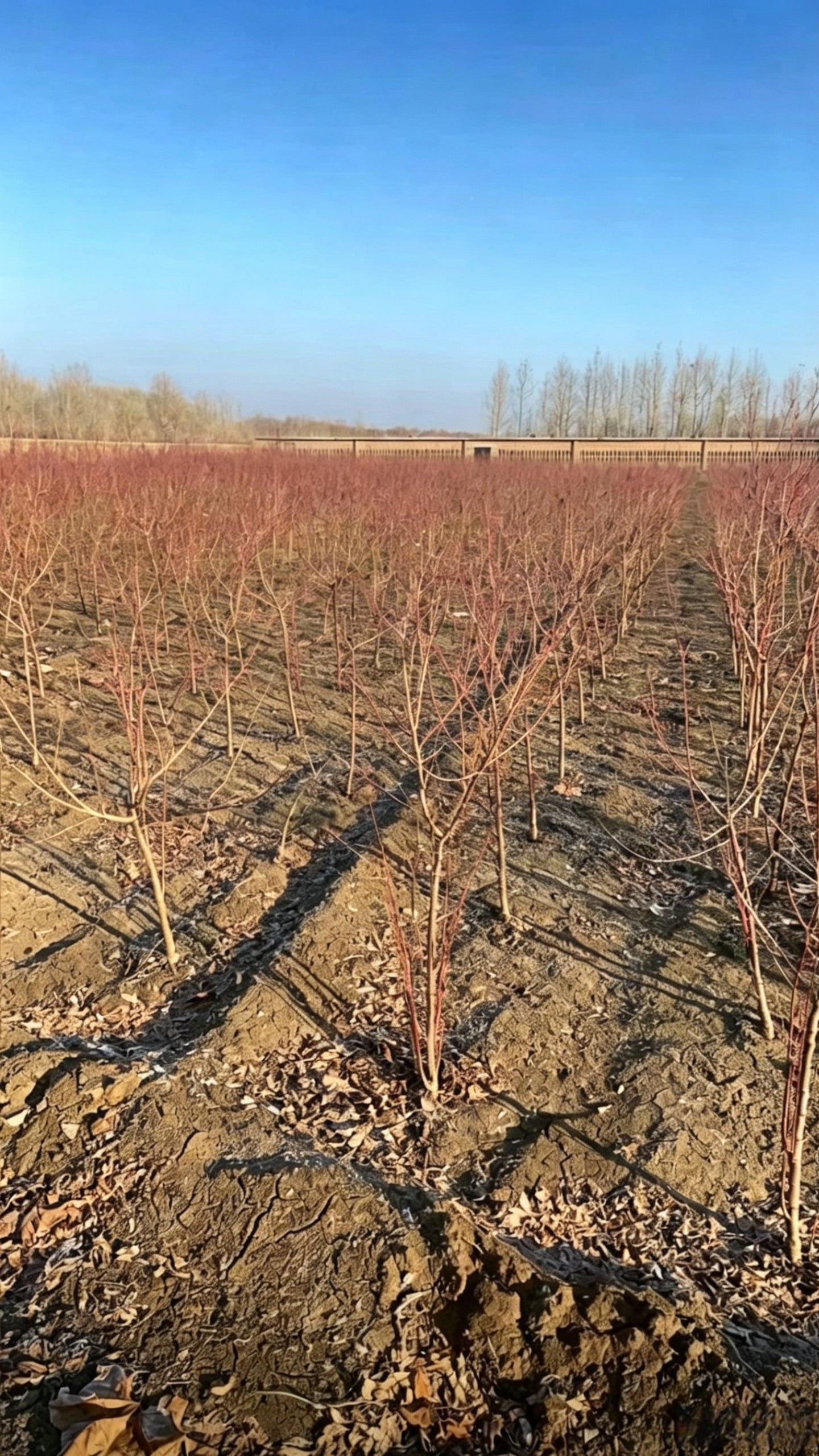
Scientific Name: Prunus persica f. atropurpurea (Schneid.) Voss
Synonyms: Purple-leaf Peach, Red Flowering Peach
Classification: Rosaceae, Prunus · Deciduous Small Tree / Colored-leaf Flowering Tree
1. Variety Characteristics
-
Plant Morphology: Deciduous small tree, 3–5 m tall, with dark brown bark. The most notable feature is that the leaves remain purple-red or dark red throughout the year. Leaves are long lanceolate with fine serrated margins.
-
Flower Performance: Flowers appear before leaves or together with leaves. Flowers are double, bright red (also found in pink), and eye-catching. Flowering period is March–April.
-
Ornamental Value: Blossoms are like brocade in March, and leaves are red like fire in April. It is an excellent variety where "both flowers and leaves are beautiful".
2. Ecological Habits
-
Light: Strongly heliophilic species, prefers full sun. Insufficient light will turn leaf color green and significantly reduce the volume of flowers.
-
Soil: Prefers well-drained sandy loam. Extremely sensitive to waterlogging (common to peaches; waterlogging for 2–3 days can cause death). Relatively tolerant of drought and salt-alkali.
-
Temperature and Humidity: Strong cold resistance; can be cultivated in open ground in North China, Northwest China, and the Yangtze River basin.
-
Lifespan and Pruning: Relatively short lifespan (20–30 years), but grows fast and is highly tolerant of pruning.
3. Landscape Application Scenarios
-
Street Tree / Green Belt Accent: Planted in rows in urban green belts, creating a visual impact of "a splash of red in a sea of green".
-
Lawn Specimen / Paired Planting: Planted as specimens in open lawns or in front of buildings to display the seasonal beauty of spring flowers and autumn leaves.
-
Flower Border Background: As a background for flower borders, the purple-red leaves can beautifully set off the light-colored perennial flowers in front.
4. Seedling Quality Indicators (Example — Landscape Large Seedling)
Item Name |
Specifications |
|---|---|
DBH / Ground Diameter |
Φ 4 cm / Φ 6 cm / Φ 8 cm / Φ 10 cm (Graded by design) |
Height (H) |
200–400 cm (Matches DBH) |
Crown Width (P) |
≥ 150–250 cm, crown is rounded and uniform without obvious damage |
Branching Point |
Usually 80–120 cm, high-branching seedlings can also be selected as needed |
Root Ball Specs |
8–10 times the DBH; must ensure the root ball doesn't break and roots are intact |
Quality Requirements |
Main stem has no canker, no trunk-boring pests, vigorous growth, leaf color is bright red and normal |
5. Planting and Maintenance Points
-
Drainage and Flood Prevention: Low-lying areas must be raised with soil. Strengthen drainage in the rainy season to prevent death from root rot.
-
Pruning: Heavy pruning after flowering. Promptly remove overly dense inner branches, drooping branches, and overlapping branches to ensure light and make leaf color more brilliant.
-
Fertilization: Apply nitrogen fertilizer before spring budding, phosphorus and potassium fertilizer after flowering and in autumn, and base fertilizer before winter.
-
Pest and Disease Control: Focus on preventing gummosis, aphids, red spider mites, and longhorn beetles.