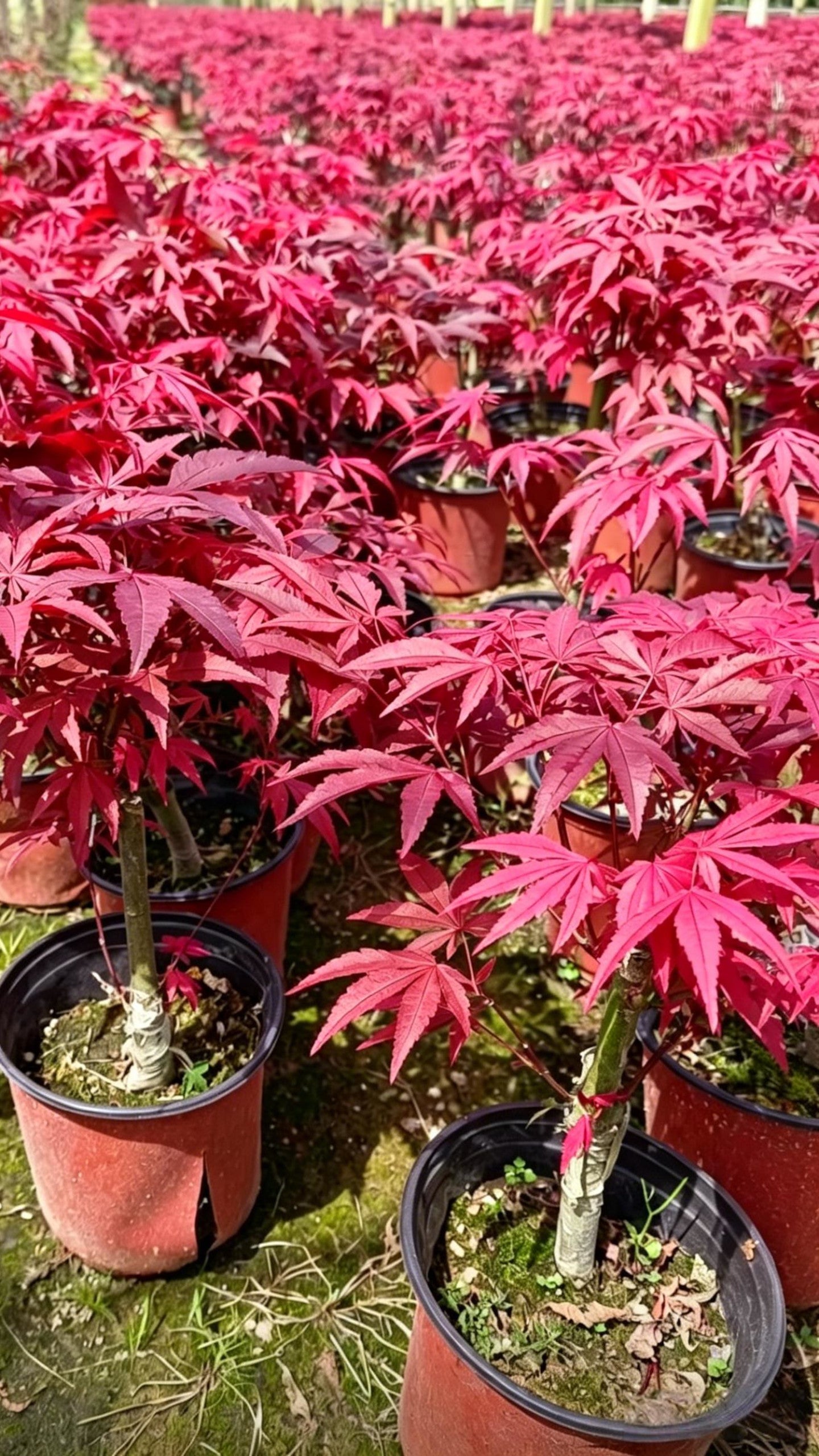
Scientific Name: Acer palmatum 'Atropurpureum' (Purple-red leaf group)
Aliases: Purple Japanese Maple, Red Leaf Japanese Maple
Classification: Sapindaceae (formerly Aceraceae), Acer genus · Deciduous small tree / Ornamental foliage tree (Cultivar of Japanese Maple)
1. Variety Characteristics
-
Plant Morphology: Deciduous small tree, 3–6 (up to 8) m tall; umbrella-shaped or flattened round crown; branchlets purple-red or purple-brown; leaves opposite, palmate 5–9 deeply lobed (usually 7-lobed, same as Japanese Maple), lobes lanceolate with doubly serrated margins. The fundamental difference from Green Japanese Maple: New leaves through summer are purple-red or dark purple-red (deepest under strong light), occasionally slightly greening only under extreme heat and intense light in midsummer, and turning bright red again in cool autumn.
-
Common Cultivars:
-
A. palmatum 'Atropurpureum' (Typical Red Maple, purple-red leaves)
-
'Bloodgood' (Deep purple-red, strong resistance to greening)
-
'Dissectum Atropurpureum' (Red Laceleaf Maple, finely dissected pendulous lobes, shrub-like)
-
-
Seasonal Performance: Bright purple-red spring leaves → Dark purple-red in summer (some varieties slightly darker) → Turns bright red or orange-red in autumn, offering significant year-round foliage effects.
2. Ecological Habits
-
Light: Prefers dappled shade (partial sun is best); avoid intense direct sunlight (summer afternoon sun causes leaf scorch, burns, and greening); morning sun + afternoon shade is ideal.
-
Soil: Strictly prefers acidic, loose, fertile, well-drained sandy loam (pH 5.5–6.5); avoid alkaline soil (causes chlorosis) and waterlogging (causes root rot).
-
Temperature & Humidity: Relatively cold-hardy (tolerates short-term lows around -15°C), but dislikes dry cold northern winds and intense dry heat; prefers humid environments.
-
Resistance: Strong budding ability, tolerates pruning; pests and diseases mainly include longhorn beetles, scale insects, and leaf spot.
3. Engineering Application Scenarios
-
Solitary/Pair Planting: Planted in lawns, entrances, beside stones, or poolside as a specimen tree for "finishing touch" autumn color.
-
Group Planting: Arranged with evergreens (e.g., Junipers, Pines) to create a striking "red among the green" contrast effect.
-
Bonsai Display: Elegant tree form, highly suitable for large and medium-sized bonsai, displayed in courtyards, light wells, or terraces.
4. Sapling Quality Indicators (Example - High-Quality Specimen Trees)
|
Project Item |
Specifications & Parameters |
|---|---|
|
DBH / Ground Diameter |
Φ 3 cm / Φ 5 cm / Φ 6 cm / Φ 8 cm (graded by design; large Red Maple specimens are rare) |
|
Height (H) |
150–300 cm (matched according to DBH) |
|
Crown Spread (P) |
≥ 120–200 cm, symmetrical and full crown, no lopsidedness |
|
Branching Point |
Uniform and neat (usually 60–100 cm or as required), 3–5 main branches layered |
|
Root Ball Specs |
8–10 times the DBH, intact root system |
|
Quality Requirements |
Grafted seedlings, graft union healed smoothly without "constriction"; normal purple-red leaf color (not greening); free of quarantine pests and diseases; specify variety (e.g., Atropurpureum / Bloodgood, etc.) |
5. Planting and Maintenance Points (for Annex)
-
Planting Season: Highest survival rate when transplanted after leaf fall in late autumn/early winter or before budding in early spring (Feb-Mar); root ball diameter 8–10 times the DBH.
-
Pruning: In winter dormancy, prune leggy and crossing branches; during growing season, only perform minor bud thinning and pinching to maintain crown shape.
-
Water & Fertilizer: Avoid drought; requires timely irrigation and misting for cooling in high summer; apply compound fertilizer once in early spring and organic fertilizer (decomposed oil cake, etc.) before winter.