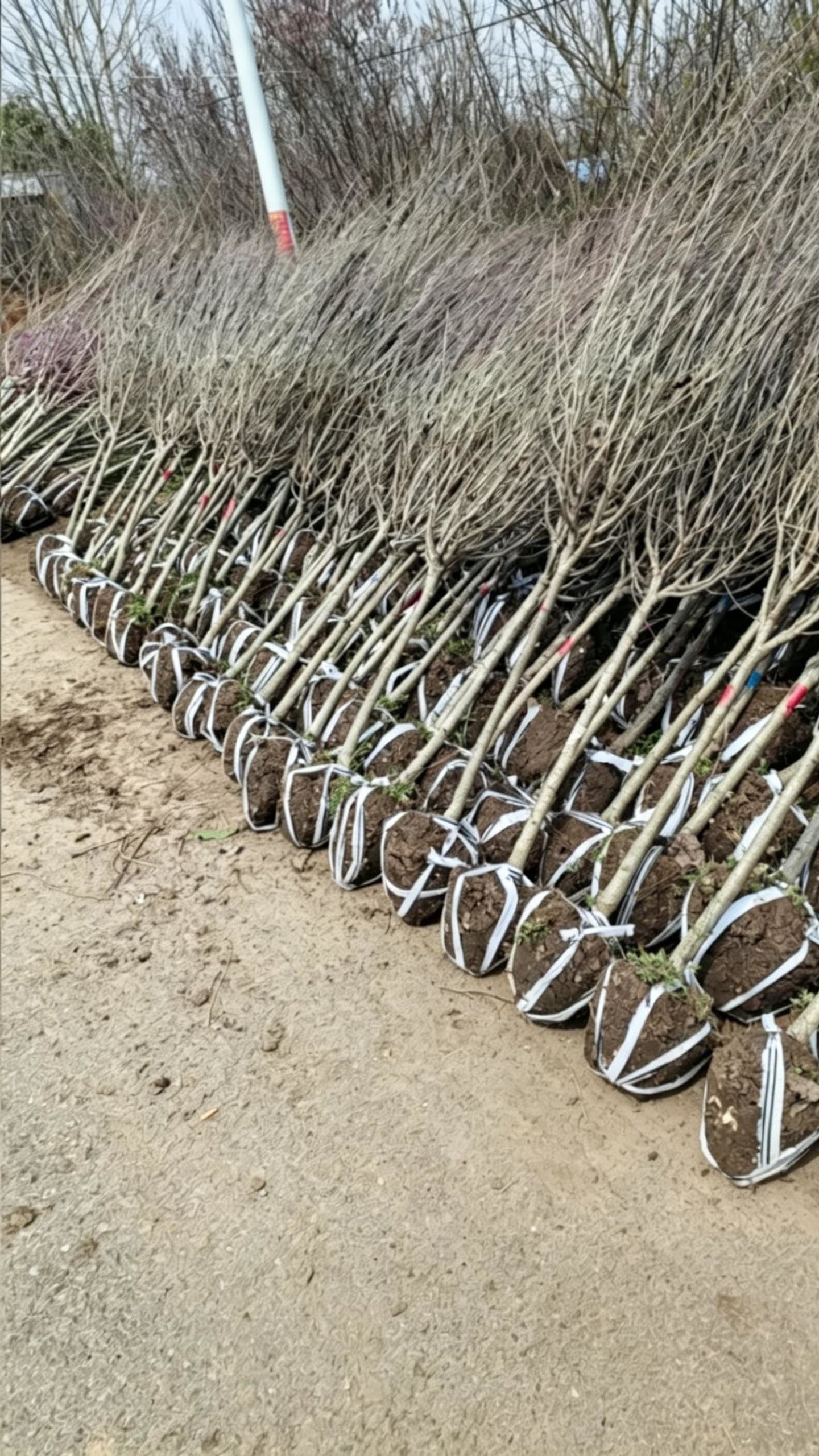
Scientific Name: Cercis chinensis Bunge (Standard Type)
Synonyms: Mantiaohong (Tree-form), Redbud Tree
Classification: Fabaceae, Cercis · Deciduous Tree (Man-made form) / Early Spring Flowering Tree
1. Variety Characteristics
-
Plant Morphology: Altering the traditional clump-forming habit of Chinese Redbud, a tree shape with a distinct straight single stem (stem height 1.5–2.5 m) is cultivated through early pruning or grafting. The bark is grayish-white and smooth.
-
Flower Performance: Flowers appear before leaves. The flowers are butterfly-shaped, purple-red, and grow in clusters on old branches or even the main stem. They are extremely dense, resembling purple silk ribbons (hence the name Redbud). Flowering period is March–April.
-
Leaf Characteristics: Simple leaves are alternate, heart-shaped or nearly round, 6–14 cm long, with entire margins. The leaf surface is green and glossy.
2. Ecological Habits
-
Light: Prefers light but also tolerates partial shade; flowers more profusely in full sun.
-
Soil: Not demanding on soil, but grows best in well-drained, loose, fertile loam. Avoid waterlogging (easily causes root rot).
-
Temperature and Humidity: Relatively cold-resistant (can withstand environments above -15°C) and highly adaptable.
-
Features: Roots have rhizobia with nitrogen-fixing capabilities to improve soil. Sensitive to transplanting (large seedlings must be moved with a large root ball).
3. Landscape Application Scenarios
-
Intersection Accent/Paired Planting: The standard form solves the visibility obstruction problem of traditional clump-forming Redbuds, making it suitable for planting at intersections or on both sides of steps.
-
Lawn Specimen: Acts as a primary spring flowering feature tree, with an evergreen forest belt as a backdrop for sharp contrast.
-
Courtyard Planting: Elegant tree posture and symbolic meaning of "family reunion" (due to the clustered flowering habit) make it popular in private gardens.
4. Seedling Quality Indicators (Example — Premium Large Standard Seedling)
Item Name |
Specifications |
|---|---|
DBH / Ground Diameter |
Φ 5 cm / Φ 7 cm / Φ 8 cm / Φ 10 cm (Customizable) |
Stem Height (H) |
180–220 cm / 250 cm (Branching points are neat and consistent) |
Crown Width (P) |
≥ 150–200 cm, crown is rounded and skeleton is uniform |
Root Ball Specs |
8–10 times the DBH, packed as a root ball with intact roots |
Quality Requirements |
Main stem is straight without obvious curves or damage, flower buds are full, no trunk-boring pests |
5. Planting and Maintenance Points
-
Transplanting Requirements: Must be transplanted with a root ball. It is recommended to complete this before spring budding, and planting should not be too deep.
-
Pruning: Remove faded flowers and pods after flowering to reduce nutrient consumption. Prune diseased, pest-infested, and overly dense branches in winter to keep the crown ventilated and well-lit.
-
Water and Fertilizer: Prefers fertilizer. Apply organic fertilizer once in early spring and once after flowering. Provide timely water during summer droughts and ensure drainage during the rainy season.
-
Pests and Diseases: Focus on preventing Redbud leaf spot and trunk-boring pests.