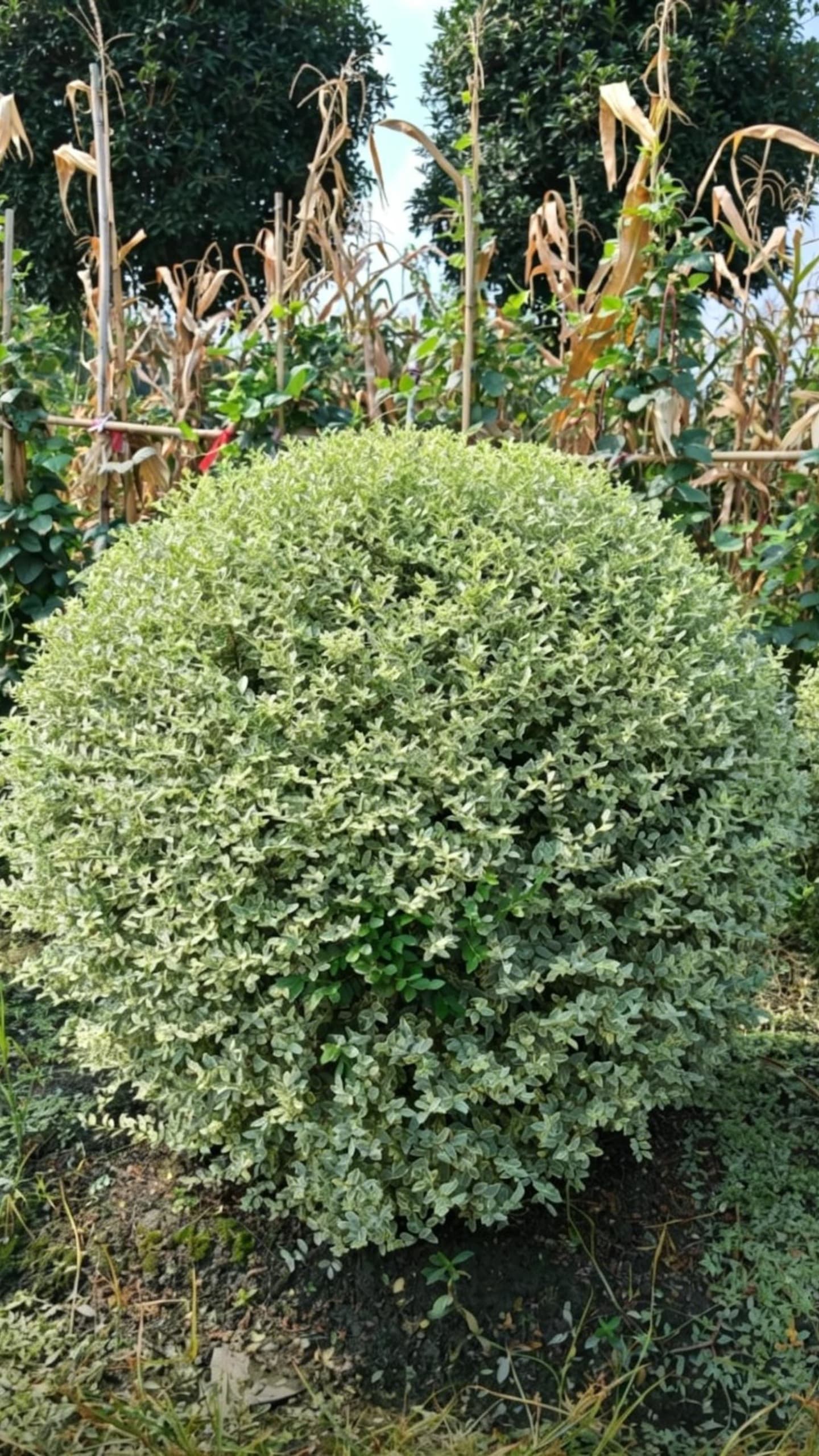
Scientific Name: Ligustrum sinense 'Variegatum' (Silver Variegated Chinese Privet Topiary Specimen)
Common Names: Variegated Chinese Privet Ball, Variegated Privet Ball, Silver-edged Privet Ball
Classification: Oleaceae, Ligustrum · Evergreen Shrub → Pruned Topiary Ball
1. Varietal Characteristics
-
Morphology: Evergreen shrub with densely pubescent branchlets; leaves opposite, elliptical or ovate-elliptical, 2–5 cm long. Leaf surface is deep green with striking creamy-white or white margins (silver edges); some leaves may be entirely white or mottled.
-
Topiary Description: This product consists of Variegated Chinese Privet shaped through repeated pruning into a spherical topiary ball. It features dense branching and fine leaves, presenting an overall pale green to silver-white tone, making it an excellent bright-colored accent plant.
-
Seasonal Performance: Colorful foliage year-round. New spring leaves are most brilliant in silver-white; foliage remains steady in summer and autumn; evergreen in winter with extremely high landscape stability.
2. Ecological Habits
-
Light: Prefers full sun, tolerates partial shade. Silver edges are most distinct in full sunlight; prolonged excessive shade may cause leaves to revert to green or drop.
-
Soil: Highly adaptable to various soils; tolerant of poor, dry, and saline-alkali conditions. Prefers well-drained sandy loam; avoid waterlogging.
-
Resistance: Relatively cold-hardy (tolerates temperatures down to approx. -10°C; widely cultivated outdoors south of East China). Highly tolerant of heavy pruning and resistant to harmful gases (e.g., sulfur dioxide).
3. Landscape Application Scenarios
-
Highlighting: Planted in front of dark green evergreen groves (such as Yew or Glossy Privet), using its silver-white foliage as a visual highlight to break monotony.
-
Color Block Combinations: Mixed with Loropetalum balls (purple-red) and Golden Privet balls (golden yellow) to create a striking three-color spherical composition.
-
Formal Alignment: Arranged in rows along roadsides, greenways, or as flower border backgrounds to guide vision and define spaces.
4. Quality Indicators (Example — Project Topiary Ball)
5. Planting and Maintenance Points-
Planting Period: Best in Spring (March–May) or Autumn (October–November); containerized seedlings can be planted year-round.
-
Pruning: Topiary balls require regular pruning to maintain shape, typically 2–4 times during the growing season (May–October). Reverted pure green branches should be removed from the base immediately.
-
Water and Fertilizer: Apply compound fertilizer 1–2 times during the growing season. Ensure watering during dry seasons to maintain leaf color and vigor.
| Item | Specifications |
|---|---|
| Crown Width (P) | P40 / P60 / P80 / P100 cm (graded as requested) |
| Height (H) | ≈ 0.8-1.0 times crown width, well-rounded and symmetrical |
| Branching | 3+ year old seedlings, dense branching, no bare spots |
| Root Ball Specs | P < 80 cm, root ball Ø 15-20 cm |
| Quality Requirements | Shape pruned, free of scale; clear silver edges, normal leaf color |